We design and engineer custom solutions for all types of equipment, including:
Chiller units – air-cooled or water-cooled, configurable for any temperature range
Adiabatic cooling systems – high-efficiency alternatives to cooling towers with reduced water usage
Pump skids – complete with pumps, controls, valves and instrumentation
Heat exchanger packages – plate, shell & tube, brazed, or specialist materials
Filtration systems – to protect equipment and maintain water quality
Glycol systems & low-temperature packages
Heating and Cooling built specifically for unique processes
Whether your solution requires a carefully selected off-the-shelf product or a completely bespoke manufacturing design, we ensure it is engineered to deliver:
Optimal cooling capacity
Energy-efficient operation
Long-term reliability
Seamless integration into your process
Low total cost of ownership
Flexibility for future expansion
By working with multiple manufacturers, not being tied to a single supplier, we can combine the best technologies to create the ideal system layout for your site. Every design can be supported with detailed engineering documentation, process analysis and optional 3D system modelling for complete clarity before installation.

We manage all groundworks, bases, plinths, concrete pads and builder’s work required for equipment installation.
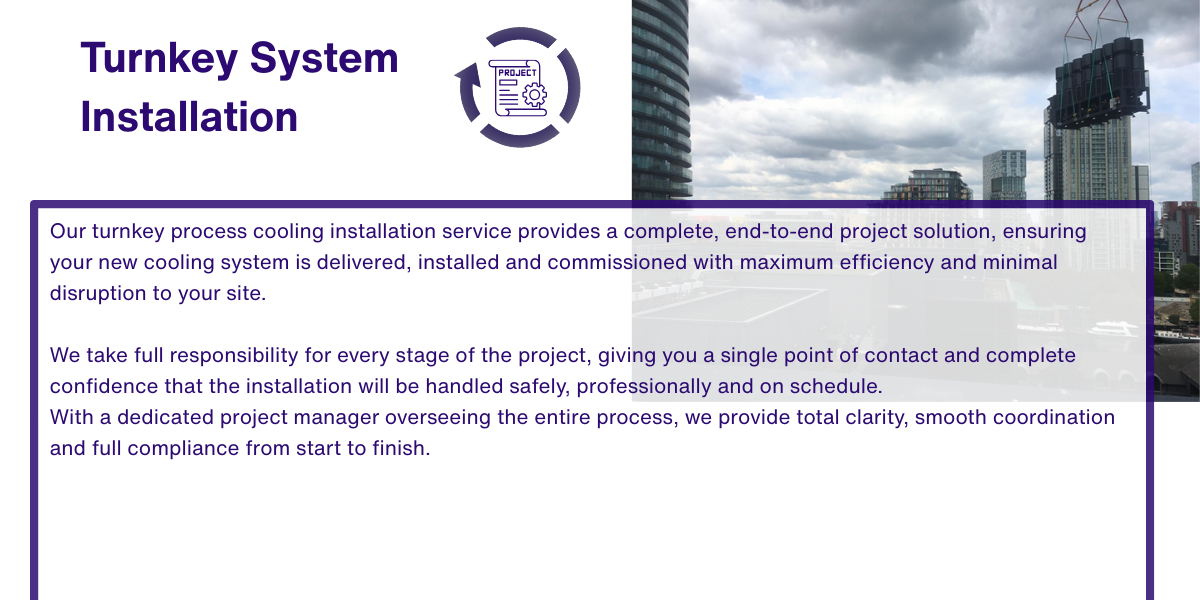
We safely offload and move equipment into place, using cranes, forklifts or specialist lifting equipment, ensuring correct positioning with full risk assessment.
We decommission and remove redundant or outdated cooling systems, including pipework, electrical supplies, tanks, and associated plant.
To minimise on-site disruption and improve health & safety, we can design and build skid-mounted cooling packages that arrive pre-assembled and pre-tested.
This reduces installation time, simplifies logistics, and limits hot works and high-risk activities on your site.
Conducted prior to delivery, FAT ensures your equipment is fully tested, configured and compliant before it leaves the manufacturer.
Once installed, we perform site acceptance tests to verify performance, safety and integration with your plant.
We fill and pressurise the new system, including water treatment, filtration and glycol where required.
To eliminate installation issues, we offer 3D model visualisations that show equipment placement, pipe routes, access zones and plantroom layout before work begins.
We can take full responsibility for CDM (Construction Design & Management) Regulations where required.
This includes:
Principal contractor role
Health & safety planning
RAMS documentation
Site coordination
Contractor management
Compliance with legal obligations
This ensures your project meets all safety and construction standards from start to finish.
Managed by a dedicated project manager
Reduced downtime & disruption
Safer installation with skid-mounted options
Full mechanical, electrical & civils capability
Seamless removal of old equipment
Full testing: FAT & SAT
3D models for total design clarity
Complete CDM compliance available
UK-wide installation coverage

Many system issues; high running costs, unstable temperatures, poor control response, noise, pump problems, or early equipment failure, can be traced back to inadequate or incomplete commissioning.
Correct commissioning ensures:
The system performs to the original design intent
Energy efficiency is maximised from day one
Correct flow, pressure and temperature profiles
Refrigeration circuits operate within safe limits
Pumps, valves and controls are correctly balanced
Alarms and safety interlocks function properly
Chillers respond correctly to load changes
The system is stable, safe and reliable
Commissioning isn’t a box-ticking exercise, it’s a highly technical process that determines how well your cooling plant will run for the next 10–15 years.
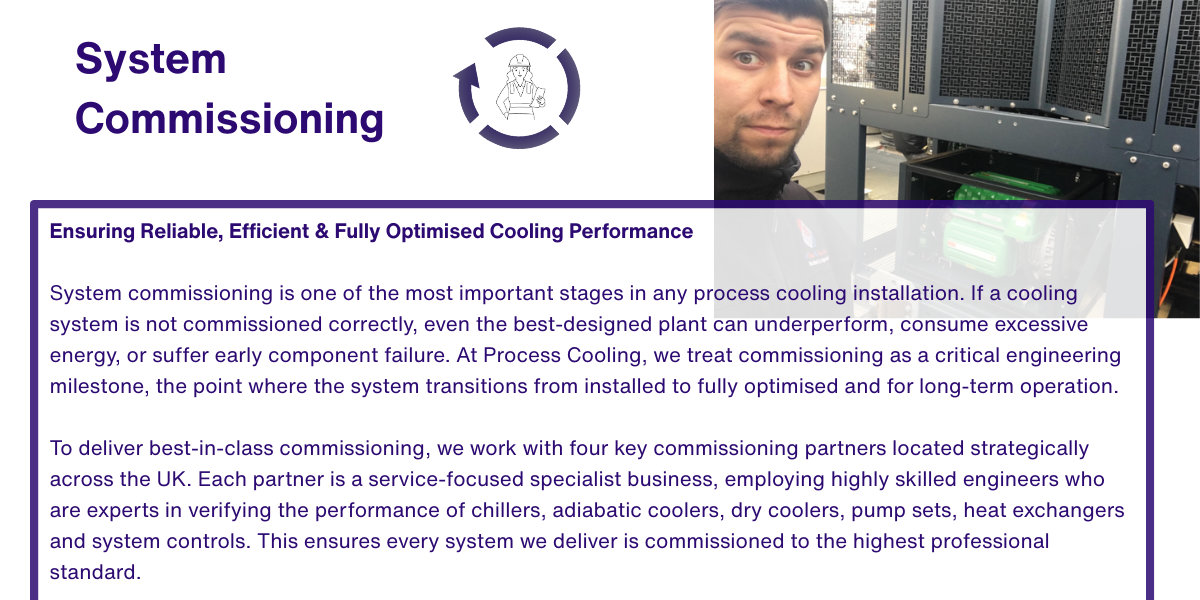
To guarantee the system performs exactly as engineered, our design team also attends site during final commissioning.
This ensures:
The installed system matches the design
Control logic is set correctly
Flow and pressure values are confirmed
Pump sets and pipe circuits are optimised
Temperature targets and safety bands align with design parameters
Any final adjustments enhance long-term efficiency
This dual-approach, commissioning engineers + design engineers, ensures your equipment is handed over in perfect working condition.
Our full commissioning process covers:
System flushing & cleaning
Refrigeration performance checks
Pump balancing & flow verification
Temperature calibration
BMS and control strategy configuration
Alarm and safety device testing
Electrical and mechanical verification
Load testing where possible
Final system optimisation
Comprehensive commissioning report
We do not leave site until the system is running reliably, efficiently, and exactly in line with the intended design.
Four trusted UK commissioning partners
High-level engineering expertise
Design team attendance for final commissioning
Detailed documentation and reporting
Focus on efficiency, reliability and performance
Experience across all major industrial sectors
Commitment to long-term system success

Every maintenance contract includes a structured forward-planning strategy, giving you a clear roadmap for the next: 1 year, 3 years, 5 year 10 years
This long-term plan forecasts:
Expected component lifecycles
Recommended upgrades or replacements
Energy-efficiency improvement opportunities
End-of-life planning
Budget forecasting
Risk reduction & downtime mitigation
Reliability-centred maintenance priorities
We present this strategy to you in a professional PowerPoint presentation, which your management team can easily review, share, and integrate into internal planning.
This makes our maintenance contracts an essential part of business continuity planning, not just equipment servicing.
Where systems allow, we strongly encourage the use of remote monitoring. This helps identify issues before they become failures and allows us to offer a highly proactive service.
Remote monitoring benefits include:
Early detection of performance drops
Alerts for temperature, pressure or flow deviations
Predictive maintenance capability
Reduced downtime & emergency callouts
Better energy performance insights
Data-driven optimisation recommendations
Remote monitoring provides a deeper understanding of how your cooling system performs day-to-day, giving you confidence in both reliability and efficiency.
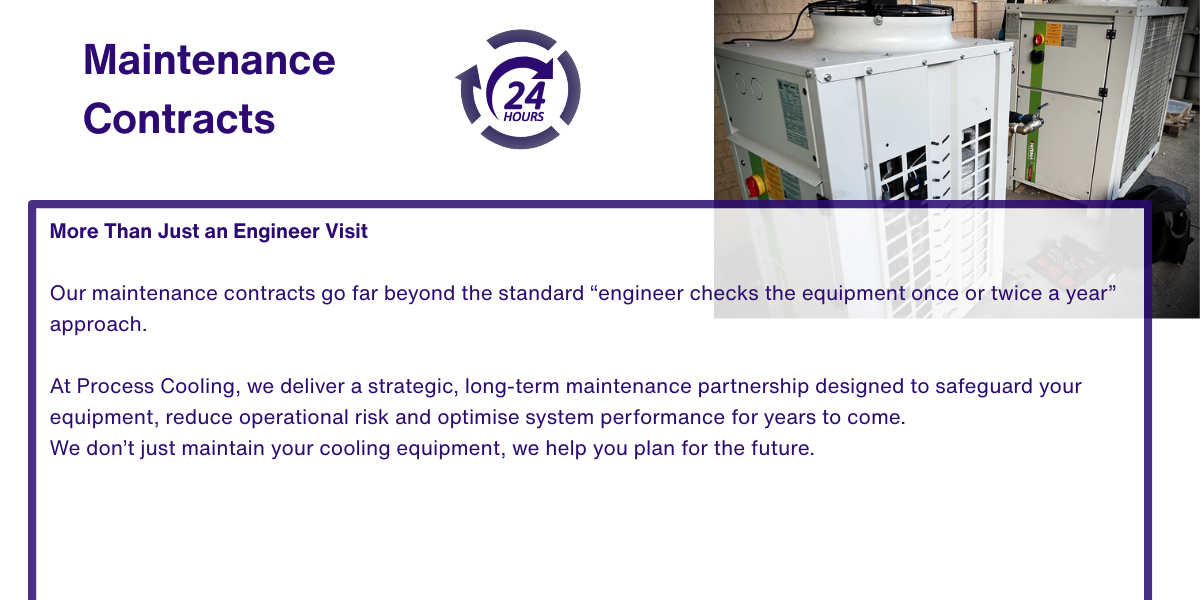
Alongside strategy and monitoring, our engineers still perform comprehensive hands-on maintenance on all cooling equipment, including:
Chillers
Adiabatic coolers
Dry coolers
Pump sets
Heat exchangers
Controls & sensors
Water treatment
Filtration systems
Third-party equipment
Every visit includes full system checks, performance testing, safety validation and clear service reports.
Improved reliability and reduced downtime
Lower operating and energy costs
Longer equipment lifespan
Clear long-term planning & budgeting
Transparent asset management
Early fault detection and prevention
Priority response for contract customers
Support for all equipment brands and manufacturers

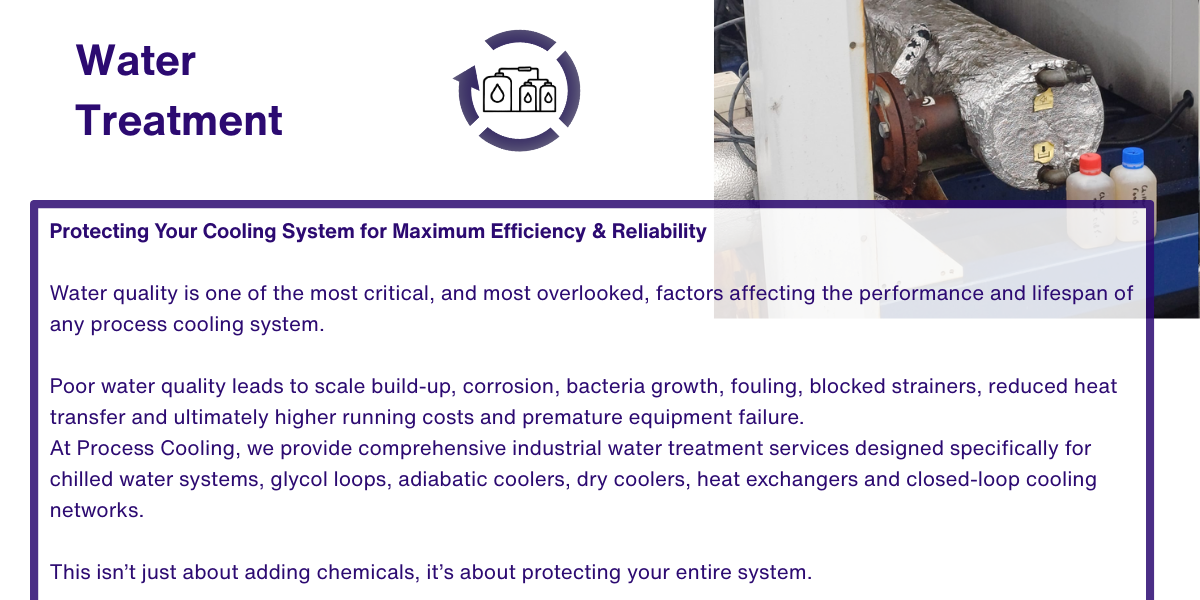
Cooling systems without proper treatment often experience:
Scale on heat exchangers (reducing efficiency)
Corrosion inside pipework and chillers
Biofilm and bacteria formation
Blockages in strainers, pumps and valves
Increased energy consumption
Unstable system flow rates
Higher maintenance costs
Shortened equipment life
Even the most advanced cooling system will underperform if the water inside it isn’t correctly managed.
We supply and dose high-quality corrosion inhibitors, scale protectors and biocides specifically designed for cooling system conditions.
We protect your closed-loop chilled water network from corrosion, fouling and microbiological growth — essential for long-term reliability.
We remove contaminants, sludge and scale from existing systems and restore design performance, perfect before upgrades or plant changes.
We take onsite samples and provide full lab reports, giving you a clear picture of system health and highlighting corrective actions.
We specialise in glycol systems, ensuring correct concentration, cleanliness, compatibility and freeze-point protection.
We supply and install filtration systems to continuously clean the water as the plant runs.
We protect adiabatic systems from scale, bacteria and drift issues — essential for performance and compliance.
We identify and treat bacteria growth, biofilm formation and conditions that lead to contamination.
Poor water quality can reduce cooling efficiency by 10–30%, significantly increasing your energy bill.
By maintaining clean, stable water chemistry, you benefit from:
Lower energy consumption
Extended equipment lifespan
Reduced maintenance visits
Fewer breakdowns
Improved heat transfer
Stable system flow and pressure
Safer overall operation
Well-treated water ensures your cooling system operates as efficiently as it was designed to.
Water treatment can be included as part of our long-term maintenance strategy, ensuring:
Regular sampling
Updated test certificates
Accurate chemical dosing
Long-term corrosion monitoring
Predictive maintenance insights
Compliance with environmental standards
This aligns with your 1-3-5-10 year cooling roadmap and supports Net Zero goals through improved efficiency.
Specialist knowledge of cooling system chemistry
Reliable, high-performance treatment products
Full support for glycol and low-temperature systems
Independent advice — not tied to one supplier
Full sampling, testing and reporting
Integrated service with maintenance contracts
Focus on efficiency, reliability and long-term protection

Sizing and load calculations, Selecting the best hire provider, Arranging delivery, installation & commissioning, Integration with your existing system, Ongoing monitoring & support
We guide you on equipment selection, Help you communicate with hire companies, Review quotes and proposals, Ensure you receive the correct solution
Either way, you gain access to professional engineering insight and trusted UK hire suppliers.
Because we partner with multiple national hire providers, we can arrange:
Short-term hire
Long-term hire (including multi-year agreements — 5 years and beyond)
Emergency same-day hire
High-capacity MW-scale cooling solutions
Small, single-unit hire options (such as pumps or small chillers)
No requirement is too big or too small — from supplying a single pump to an entire MW-level temporary cooling plant, we have the connections and knowledge to deliver the right solution.
Our hire partners can provide a full range of temporary equipment, including:
Process chillers
Air-cooled and water-cooled chillers
Pump skids and standalone pumps
Air handling units (AHUs)
Heat exchangers
Dry coolers & adiabatic units
Boilers & temporary heating systems
Space heating & building heating systems
Temporary space cooling for comfort
Hose packages, manifolds & accessories
Whether your business needs fast temporary cooling or large-scale heating support, we ensure the equipment is reliable, efficient and correctly sized for your requirements.
Access to multiple specialist hire companies
Independent, unbiased guidance
Fast turnaround during emergencies
Any scale: from single pumps to MW cooling
Temporary cooling and temporary heating solutions
Long-term and short-term hire options
Reliable, efficient and correctly sized equipment

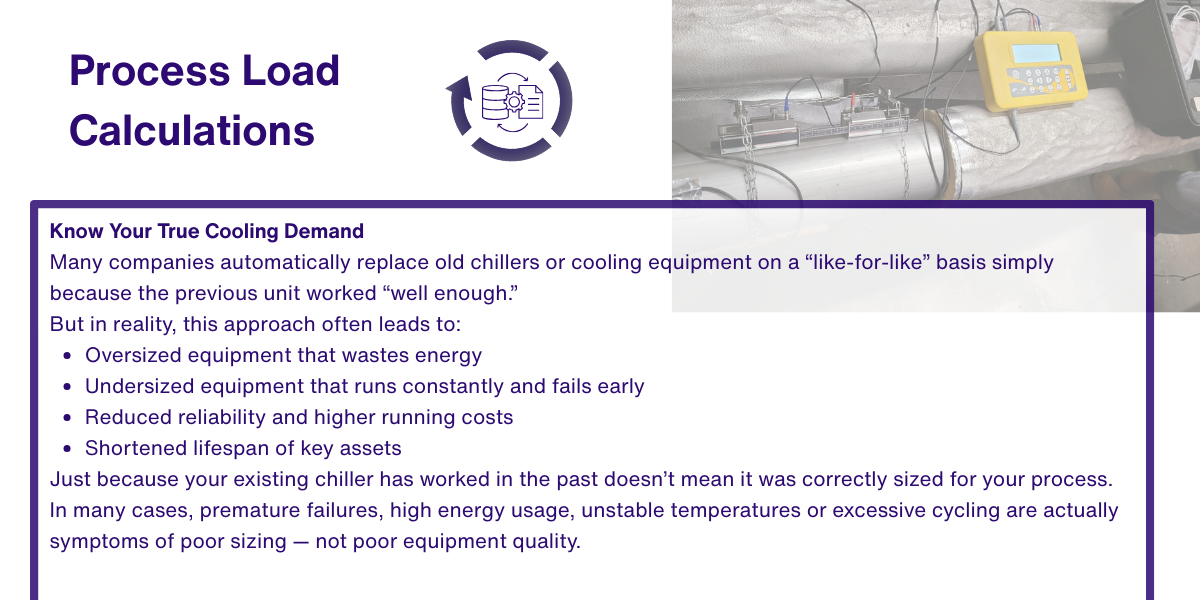
Detailed assessment of your process and equipment
Heat rejection analysis
Flow and pressure requirements
Ambient operating profiles (summer/winter)
Diversity and peak demand analysis
Redundancy planning (N+1 / duty-standby)
Future-proofing for production changes
Comparison against your existing equipment’s performance
By understanding your true load, we help prevent premature chiller breakdowns, oversized systems, energy waste, and costly mistakes during replacement.
A correctly sized system offers:
Lower operating costs
Longer equipment life
Stable, reliable temperature control
Fewer breakdowns
Better long-term asset planning
Improved production efficiency
Investing in process cooling equipment is a long-term decision — and we ensure it’s based on accurate data, not assumptions.
When you’re investing in new process cooling plant, knowing your actual thermal load is absolutely critical. It ensures:
The equipment is matched to the real process demand
Energy consumption is minimised
Reliability and system longevity are improved
Future expansion and growth are factored into the design
Capital investment is spent in the right place
Operating costs remain under control
At Process Cooling, we specialise in carrying out detailed process load calculations to establish your true cooling demand before any equipment is selected.

Its more than just a schematic we will check the system design and make recommendations of improvements, if required. Our engineers produce comprehensive schematic drawings that detail:
Flow and return pipework routes
Pumps, valves and control sequences
Heat exchangers, chillers, coolers and ancillary equipment
Sensors, gauges and monitoring points
Safety devices and isolation points
System flow direction and operational logic
Any legacy changes or undocumented modifications
These drawings give your team a complete understanding of the system layout, helping to ensure safe operation and faster decision-making.
We recommend producing or refreshing system drawings when:
Equipment has been replaced
Pipework has been altered
A new extension or production line has been added
You experience a breakdown that reveals gaps in system knowledge
Your maintenance strategy is being reviewed
You are preparing for system upgrades or expansions
.png)
Every checklist we create is based on your actual cooling system layout, design intent and performance parameters. This includes:
Key operating conditions (temperatures, flows, pressures)
Allowable safety bands and alarm thresholds
Daily and weekly operational checks
Maintenance intervals and tasks
Critical components that require regular inspection
Start-up and shutdown procedures
Escalation steps if system readings fall outside design limits
This ensures your team always knows exactly what “good” looks like — and what to do when something isn’t right.
In addition to checklists, we compile a full documentation pack that may include:
Design reports
Commissioning data
P&IDs / schematic drawings
Manuals & OEM documentation
Maintenance instructions
Control strategy explanations
Safety and compliance records
This ensures your service team has instant access to all relevant information, enabling them to maintain your system correctly, diagnose issues faster and prevent errors caused by missing or outdated paperwork.
Clear operation procedures and documentation help you:
Maintain stable and efficient cooling system performance
Reduce breakdowns caused by incorrect operation
Improve safety for engineers and operators
Avoid costly mistakes during maintenance
Ensure compliance with internal and external standards
Reduce energy waste and protect equipment life
A well-documented system is a reliable system.
.png)
Refrigerant regulations are changing rapidly globally and in the UK. High-GWP refrigerants are being phased down under F-Gas legislation, and new low-GWP alternatives require careful planning.
Our roadmap includes:
Assessment of current refrigerant types on site
Risk analysis of cost increases, availability, and phase-out timelines
Roadmap for transitioning to low GWP refrigerants
Options for natural refrigerants where suitable
System modification or replacement planning
This prevents future compliance challenges and protects business continuity.
An increasing number of refrigerants and components are being monitored or restricted due to PFAS regulations. We help you navigate:
PFAS-related refrigerant risks
Component/material suitability
Long-term compliance with environmental legislation
Minimising future liability or replacement costs
By addressing PFAS early, your business stays ahead of regulatory change.
Cooling systems can be one of the largest contributors to site operating costs. Our roadmap identifies practical, measurable ways to reduce both energy usage and maintenance spend.
Typical improvements include:
Pump optimisation
Control strategy enhancement
Improved flow management
Free-cooling integration
High-efficiency equipment upgrades
Water quality improvements
Preventative maintenance strategies
Replacement of failing/inefficient components
These changes often deliver fast payback periods and significantly lower lifetime operating costs.
Your roadmap includes a structured plan covering:
1 year: Quick wins, efficiency improvements, immediate risks
3 years: System optimisation, control upgrades, planned replacements
5 years: Refrigerant strategy, major maintenance, technology updates
10 years: Full lifecycle planning, system redesign, future expansion needs
This approach ensures you always know:
What needs doing
Why it needs doing
When it needs doing
How much it will cost
What benefits it will deliver
Your team receives this plan in a clear, board-ready PowerPoint presentation, allowing simple internal communication and budget planning.
.png)
Traditional maintenance often focuses on basic readings. But complex cooling systems require deeper understanding.
ClimaCheck allows us to analyse:
Factory/process load profile
How the chiller reacts to load changes
True system COP & EER
Compressor efficiency and condition
Superheat & subcooling behaviour
Evaporator & condenser performance
Refrigerant charge and thermodynamic behaviour
Flow rates & pump efficiency
Electrical consumption & power balance
Part-load performance
System cycling and stability
With all these insights combined, we can identify faults long before they cause breakdowns.
ClimaCheck works like a “brain” for your cooling system, analysing dozens of data points at the same time and comparing them against thermodynamic models.
This lets us pinpoint:
Hidden refrigeration issues
Undersized or oversized components
Incorrect control setup
Failing compressors
System inefficiencies
Refrigerant imbalance
Heat exchanger fouling
Risks leading to future failure
If your chiller isn’t performing correctly — but nobody can explain why — ClimaCheck will find the answer.
With the data captured, we can:
Tune your system for maximum energy efficiency
Reduce running costs
Improve chiller stability
Prevent premature component failure
Reduce compressor wear
Enhance cooling capacity & responsiveness
Support long-term asset planning
This makes ClimaCheck an essential tool for businesses aiming to improve system reliability, reduce energy usage and extend the lifespan of critical cooling equipment.
Independent, unbiased performance analysis
Engineers trained in advanced diagnostics
Data-driven recommendations
On-site or continuous monitoring options
Ideal for troubleshooting persistent or complex faults
Supports Net Zero and energy-efficiency initiatives
No matter where you’re located, our team is always ready to support you with your Process Cooling needs.
We proudly deliver our full range of products and services across the UK, ensuring every customer receives the same high level of expertise, reliability, and care - wherever their business operates